 admin
admin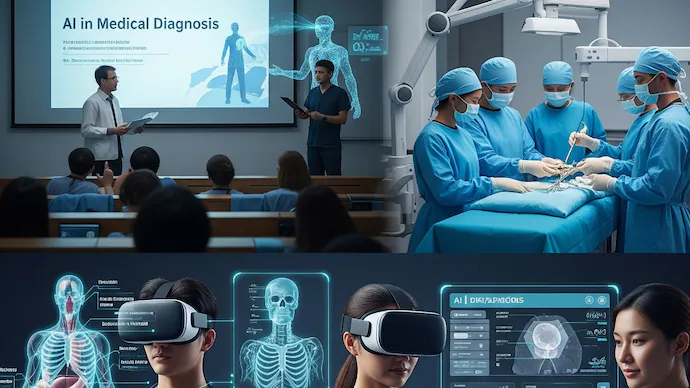
Imagine a world where medical students practice surgeries on hyper-realistic AI-powered simulators, where nurses receive personalized training in real time, and where healthcare professionals stay updated through intelligent, adaptive learning platforms. This isn’t science fiction—it’s the reality unfolding today with AI in healthcare education and training.
1. The Evolution of AI in Healthcare Education and Training
The integration of artificial intelligence into healthcare education marks a transformative shift from traditional, lecture-based models to dynamic, data-driven learning ecosystems. AI has evolved from a futuristic concept to a practical tool that enhances both the delivery and absorption of medical knowledge.
From Theory to Practice: Early Adoption of AI
In the early 2000s, AI began making inroads into medical education through basic computer-assisted learning modules. These systems offered static content and limited interactivity. However, they laid the groundwork for more advanced applications. Early adopters experimented with AI-driven diagnostic simulators, allowing students to input symptoms and receive differential diagnoses powered by rule-based algorithms.
- Initial AI tools were limited by computational power and data availability.
- Medical schools began incorporating AI-based case simulations into curricula.
- These systems helped standardize learning but lacked personalization.
The Rise of Machine Learning in Medical Training
With the advent of machine learning (ML), AI in healthcare education and training took a quantum leap. ML algorithms could now analyze vast datasets of patient records, clinical outcomes, and educational performance to tailor learning experiences. Platforms like IBM Watson began demonstrating how AI could assist in medical decision-making and, by extension, in training future clinicians.
- Machine learning enabled adaptive learning paths based on student performance.
- AI could identify knowledge gaps and recommend targeted remediation.
- Real-world data integration improved the authenticity of training scenarios.
“AI is not replacing doctors, but it is redefining how they are trained.” — Dr. Eric Topol, Director of the Scripps Research Translational Institute
2. AI-Powered Simulations and Virtual Patients
One of the most impactful applications of AI in healthcare education and training is the development of virtual patients and high-fidelity simulations. These tools allow learners to engage in realistic clinical scenarios without risking patient safety.
How Virtual Patients Enhance Clinical Reasoning
Virtual patients are AI-driven avatars that simulate real patient interactions. They respond to student inputs—such as history-taking, physical exam findings, and diagnostic decisions—with dynamic, context-aware feedback. This fosters critical thinking and clinical reasoning in a controlled environment.
AI in healthcare education and training – AI in healthcare education and training menjadi aspek penting yang dibahas di sini.
- Students can practice diagnosing rare conditions without waiting for real cases.
- AI adjusts patient responses based on the learner’s decisions, creating branching scenarios.
- Immediate feedback helps reinforce correct diagnostic pathways.
For example, the Medical Realities platform uses AI and VR to train medical students in surgical procedures and emergency response, offering immersive experiences that were previously unattainable.
High-Fidelity Simulations in Surgical Training
Surgical training has traditionally relied on cadavers and supervised operating room experience. AI is now enabling robotic simulators that replicate tissue resistance, bleeding, and anatomical variations with astonishing accuracy. These systems use haptic feedback and real-time AI analysis to guide trainees.
- AI evaluates surgical technique, instrument handling, and decision-making.
- Performance metrics are generated for objective assessment.
- Trainees can repeat procedures until mastery is achieved.
The 3D Systems Simbionix platform, for instance, offers AI-enhanced surgical simulators for laparoscopy, endoscopy, and interventional radiology, significantly improving skill acquisition and patient outcomes.
3. Personalized Learning Pathways Through AI
Every learner has a unique pace, strengths, and weaknesses. AI in healthcare education and training enables truly personalized learning by analyzing individual performance and adapting content accordingly.
Adaptive Learning Platforms
AI-driven platforms like Kaplan’s adaptive learning systems use algorithms to assess a student’s knowledge level in real time. Based on this assessment, the system adjusts the difficulty and focus of subsequent content.
- Struggles in cardiology? The AI serves more cardiology cases and foundational content.
- Excels in pharmacology? The system accelerates progress in that domain.
- Reduces time spent on mastered topics, increasing efficiency.
This personalization ensures that no student is left behind, and high achievers are continually challenged.
AI in healthcare education and training – AI in healthcare education and training menjadi aspek penting yang dibahas di sini.
Predictive Analytics for Student Success
AI doesn’t just react to performance—it can predict it. By analyzing patterns in study habits, quiz results, and engagement metrics, AI models can forecast which students are at risk of failing exams or struggling in clinical rotations.
- Early intervention programs can be triggered based on AI alerts.
- Academic advisors receive data-driven insights to support students.
- Institutions can allocate resources more effectively.
A study by the University of Florida found that AI-powered predictive analytics improved pass rates in medical licensing exams by 18% among at-risk students.
4. AI in Continuing Medical Education (CME)
Healthcare is a field of constant evolution. AI in healthcare education and training is revolutionizing continuing medical education by making it more relevant, accessible, and efficient for practicing professionals.
Just-in-Time Learning for Clinicians
AI enables just-in-time learning—delivering critical knowledge exactly when and where it’s needed. For example, a physician encountering a rare disease can access an AI-curated summary of the latest guidelines, case studies, and treatment protocols within seconds.
- AI-powered CME platforms push updates based on a clinician’s specialty and patient load.
- Microlearning modules fit into busy schedules.
- Content is continuously updated from peer-reviewed journals and clinical trials.
Platforms like UpToDate integrate AI to highlight changes in clinical recommendations, ensuring practitioners stay current.
AI-Driven Certification and Competency Tracking
Maintaining certification is a regulatory requirement for many healthcare professionals. AI streamlines this process by tracking completed courses, assessing competency through simulations, and recommending necessary training.
AI in healthcare education and training – AI in healthcare education and training menjadi aspek penting yang dibahas di sini.
- Automated dashboards show progress toward recertification.
- AI identifies skill decay and suggests refresher courses.
- Reduces administrative burden on institutions and individuals.
This ensures that ongoing education is not just a box-ticking exercise but a meaningful component of professional development.
5. AI for Assessing and Improving Clinical Skills
Assessment in medical education has long relied on subjective evaluations. AI introduces objectivity, consistency, and scalability to the evaluation of clinical skills.
Automated Evaluation of Clinical Performance
AI systems can analyze video recordings of patient interactions, OSCEs (Objective Structured Clinical Examinations), and procedural skills to provide detailed feedback. Natural language processing (NLP) evaluates communication skills, while computer vision assesses technical performance.
- AI scores empathy, clarity, and diagnostic reasoning in patient interviews.
- Identifies subtle errors in technique that human evaluators might miss.
- Provides standardized assessments across large cohorts.
For instance, the Simulated Patient platform uses AI to evaluate medical students’ bedside manner and diagnostic accuracy in virtual encounters.
Real-Time Feedback and Skill Mastery
One of the greatest advantages of AI in healthcare education and training is the ability to deliver instant feedback. Whether a student is practicing suturing on a simulator or conducting a virtual consultation, AI can provide corrective guidance in real time.
- Immediate correction prevents the reinforcement of bad habits.
- Encourages deliberate practice and skill refinement.
- Supports competency-based education models.
This real-time loop accelerates the journey from novice to expert, a principle supported by research from the National Center for Biotechnology Information.
AI in healthcare education and training – AI in healthcare education and training menjadi aspek penting yang dibahas di sini.
6. Ethical and Practical Challenges of AI in Healthcare Education
While the benefits are substantial, the integration of AI in healthcare education and training is not without challenges. Ethical, technical, and pedagogical concerns must be addressed to ensure responsible implementation.
Data Privacy and Student Consent
AI systems rely on vast amounts of personal and performance data. Collecting, storing, and analyzing this data raises significant privacy concerns. Students must be informed about how their data is used and must provide explicit consent.
- Institutions must comply with regulations like FERPA and HIPAA.
- Data anonymization is critical to protect identities.
- Transparent data governance policies build trust.
Without robust safeguards, the risk of data breaches and misuse undermines the credibility of AI-driven education.
Bias in AI Algorithms
AI models are only as unbiased as the data they are trained on. If historical data reflects systemic biases—such as underrepresentation of certain demographics—AI can perpetuate or even amplify these inequities in education.
- Bias can affect who receives remedial support or advanced challenges.
- AI may favor certain learning styles over others, disadvantaging diverse learners.
- Ongoing auditing of AI systems is essential to detect and correct bias.
“If we’re not careful, AI could reinforce the very inequalities we’re trying to eliminate in healthcare.” — Dr. Ziad Obermeyer, Professor of Health Policy at UC Berkeley
Over-Reliance on Technology
There is a risk that educators and learners may become overly dependent on AI, potentially undermining critical thinking and human judgment. While AI can assist, it should not replace the mentorship and interpersonal dynamics that are central to medical training.
- Human instructors remain essential for emotional intelligence and ethical reasoning.
- AI should augment, not replace, clinical preceptors.
- Balancing technology with hands-on, human-centered learning is crucial.
7. The Future of AI in Healthcare Education and Training
The trajectory of AI in healthcare education and training points toward increasingly immersive, intelligent, and integrated learning environments. The future is not just about smarter tools, but about transforming the culture of medical education.
AI in healthcare education and training – AI in healthcare education and training menjadi aspek penting yang dibahas di sini.
AI and the Rise of Lifelong Learning Ecosystems
AI will enable continuous, lifelong learning ecosystems where healthcare professionals receive personalized updates, skill assessments, and training throughout their careers. These ecosystems will be seamlessly integrated into clinical workflows.
- AI will monitor clinical performance and suggest learning modules based on real-world outcomes.
- Learning will be embedded in daily practice, not isolated in classrooms.
- Interprofessional collaboration will be enhanced through shared AI platforms.
Imagine a nurse receiving an AI-generated alert about a new sepsis protocol just before a shift—this is the future of just-in-time, context-aware education.
Integration with Augmented and Virtual Reality
The fusion of AI with AR and VR will create hyper-realistic training environments. Surgeons could rehearse complex procedures in a virtual OR with AI-guided coaching. Medical students could explore 3D anatomical models that respond to touch and voice commands.
- AI will generate dynamic scenarios based on real patient data.
- VR simulations will adapt in real time to learner decisions.
- Remote learners will access high-quality training regardless of location.
Companies like Osso VR are already pioneering this space, combining AI and VR for orthopedic surgical training with measurable improvements in skill retention.
Global Access to Quality Medical Education
AI has the potential to democratize medical education. In low-resource settings, AI-powered platforms can deliver high-quality training to students and practitioners who lack access to traditional institutions.
- AI tutors can provide instruction in multiple languages.
- Offline-capable apps can function in areas with limited internet.
- Standardized training reduces disparities in care quality.
Initiatives like the World Health Organization’s Digital Health Academy are leveraging AI to train healthcare workers in underserved regions, bridging the global education gap.
AI in healthcare education and training – AI in healthcare education and training menjadi aspek penting yang dibahas di sini.
What is AI in healthcare education and training?
AI in healthcare education and training refers to the use of artificial intelligence technologies—such as machine learning, natural language processing, and computer vision—to enhance the teaching, learning, and assessment of medical and healthcare professionals. It includes applications like virtual patients, adaptive learning platforms, and AI-driven simulations.
How does AI improve medical training?
AI improves medical training by personalizing learning experiences, providing real-time feedback, enabling high-fidelity simulations, and predicting student performance. It allows learners to practice in safe, controlled environments and helps educators identify knowledge gaps and intervene early.
Are there ethical concerns with using AI in medical education?
Yes, key ethical concerns include data privacy, algorithmic bias, and over-reliance on technology. Ensuring informed consent, auditing AI systems for fairness, and maintaining human oversight are critical to responsible implementation.
AI in healthcare education and training – AI in healthcare education and training menjadi aspek penting yang dibahas di sini.
Can AI replace medical teachers?
No, AI cannot replace medical teachers. While AI can automate certain tasks and enhance instruction, the mentorship, emotional intelligence, and ethical guidance provided by human educators remain irreplaceable. AI should be viewed as a tool to augment, not replace, human instructors.
What is the future of AI in healthcare training?
The future includes AI-integrated lifelong learning ecosystems, immersive AR/VR training, and global access to high-quality education. AI will become seamlessly embedded in clinical workflows, offering just-in-time learning and continuous skill assessment for healthcare professionals worldwide.
The integration of AI in healthcare education and training is not a distant possibility—it is happening now, reshaping how medical knowledge is delivered, absorbed, and applied. From virtual patients to adaptive learning platforms, AI is making education more personalized, efficient, and effective. While challenges around ethics, bias, and privacy remain, the potential benefits are too significant to ignore. As technology continues to evolve, so too must our approach to training the next generation of healthcare providers. The future of medical education is intelligent, immersive, and inclusive—and AI is leading the way.
AI in healthcare education and training – AI in healthcare education and training menjadi aspek penting yang dibahas di sini.
Further Reading: